


Welcome to our
May Newsletter
This month has been one of the most significant in recent memory for Australian property owners and buyers.
The RBA lifted the cash rate for the third time this year, and Treasurer Jim Chalmers handed down a Federal Budget that reshapes the rules for investors, first home buyers, and everyday Australians alike.
We’ve pulled together the key updates below.
Federal Budget 2026–27
The Federal Budget was handed down on 12 May. Here’s what matters most if you own property, are looking to buy, or run your own business.
Negative gearing and capital gains tax
From 1 July 2027, negative gearing will be limited to new residential builds only. The existing 50% CGT discount will be replaced with an inflation-adjusted cost base, and a 30% minimum tax rate on capital gains will apply to individuals, trusts and partnerships.
The important thing for existing investors: your current properties are fully grandfathered. The new rules only apply to residential properties purchased after 12 May 2026. If you have questions about what this means for your situation, it’s worth speaking to your accountant or financial adviser.
First home buyers
The 5% deposit Home Guarantee Scheme continues, meaning eligible buyers can enter the market without paying Lenders Mortgage Insurance (LMI). The Budget also commits $2 billion to housing infrastructure, targeting 65,000 new homes, and extends the ban on foreign investors purchasing existing homes.
Cost-of-living relief
A new $1,000 instant tax deduction for work-related expenses removes the receipt burden for individuals and sole traders. A Working Australians Tax Offset (WATO) of up to $250 provides additional relief from 1 July 2027. Personal income tax rates will also fall – the 16% marginal rate drops to 15% from 1 July 2026, and to 14% from 1 July 2027.
Small business and self-employed
The $20,000 instant asset write-off is now permanent for businesses with a turnover up to $10 million – meaning eligible purchases can be fully deducted in the same year rather than depreciated over time. From 1 July 2026, companies with turnover up to $1 billion will also be able to carry back tax losses from the previous two years. Again, your accountant will be best placed to advise on how these changes apply to your circumstances.
Interest rate news
The RBA raised the cash rate by 0.25 percentage points to 4.35% on 5 May – the third consecutive rise for 2026. The decision was voted 8–1 by the Board, a decisive shift from the narrow 5–4 split in March.
Australia’s annual Consumer Price Index (CPI) rose to 4.6% in March, up from 3.7% in February and marking its highest level since September 2023. The RBA’s preferred measure, underlying inflation, held at 3.3%, still above its 2–3% target band.
RBA governor Michele Bullock attributed the surge in Australian inflation to the oil price shock linked to the Middle East conflict and warned more cash rate hikes could be needed.
“It’s a real income shock for Australia and the world,” she said. “Australians are poorer because of this shock to oil, energy and other commodity prices that are being impacted.”
The next cash rate decision will be announced on 16 June. Some economists are anticipating we could see two more cash rate hikes in June and August due to the persistent inflationary pressures.
If you’re curious where your home loan stands, talk to us for a review and we’ll let you know if there’s a more competitive option available.
Home Value Movements
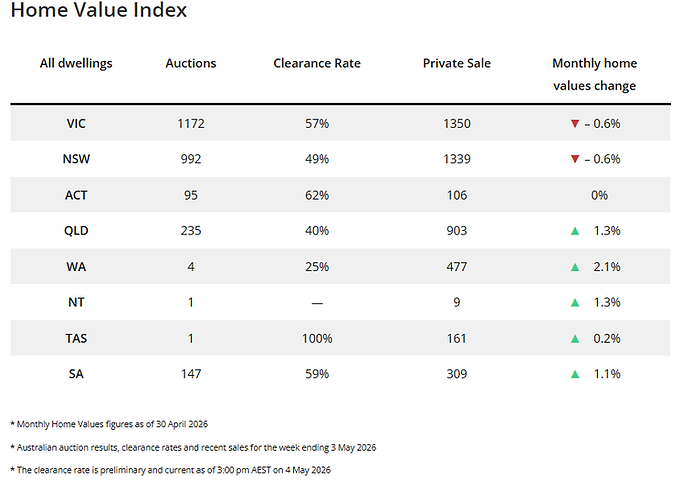
National home values increased by 0.3% in April, representing the slowest pace of growth in more than a year.
The decline was largely driven by property price falls in Melbourne and Sydney, where property values dropped 0.6% over the month, pulling down overall market performance. Growth in the mid-sized capitals also began to lose momentum in April, signalling a broader cooling trend.
According to Cotality research director Tim Lawless, this shift has been building for some time.
“The housing market has been losing momentum since late last year, as affordability and serviceability constraints weigh on demand,” he said.
“Now, with the added pressure of higher interest rates, sentiment has dropped sharply, and rising inflation is likely to push borrowing costs higher still.”
Regional markets have held up better, with prices rising 4.2% over the first four months of the year, compared to 1.8% across the combined capital cities.
However, even regional growth is starting to ease. Prices rose 0.9% in April—the slowest monthly increase in nine months—suggesting the pace of growth is beginning to moderate.
Ready to buy?
Between the Budget, rising rates and a shifting market, there’s a lot to weigh up. Whether you’re reviewing your current loan, thinking about your next purchase, or just want to understand where you stand, we’re here to help you with the next step.
Additional sources
Cotality Data Daily Home Value Index: Monthly Values
https://www.cotality.com/au/our-data/auction-results
https://www.realestate.com.au/auction-results/

Get EOFY Ready as a Property
Investor
30 June is fast approaching. For property investors, it’s a natural time to review your position and get records in order before the financial year closes.
This year there’s an added reason to take stock. The Federal Budget introduced changes to negative gearing and capital gains tax that will affect the way residential property investments are treated from 1 July 2027.
Existing properties are grandfathered, but if you’re planning your next move, it’s worth being across the details. For more information, read our Budget summary here.
With that in mind, here are a few general practical areas worth reviewing before 30 June.
Review your rental income
When was the last time you reviewed your rental return?
If it hasn’t changed for a while, it may be worth checking how it compares to similar properties in your area, particularly in the context of recent rate changes.
You can get a sense of current market conditions by researching comparable listings online or speaking with a local real estate agent. We can also provide a market insights report if that’s helpful.
If you’re considering any changes, it’s important to understand the relevant rules and requirements around rental increases, as these can vary.
Review your property expenses
It may also be a good time to take a closer look at your property-related expenses and how they compare to previous years. This can help you understand where your costs are sitting and whether there may be opportunities to review them.
Depending on your situation, some areas investors often look at include:
-
Property management fees
-
Advertising or leasing costs
-
Repairs and maintenance services
-
Insurance premiums
-
Accounting fees
-
Loan structure and interest rate
If it’s been a while since you reviewed your investment loan, we can help you understand how it compares in the current market.
Consider whether any deductions apply to your circumstances
The Australian Taxation Office (ATO) provides a list of common investment property expenses on its website.
These expenses can be broken into three categories:
-
Expenses you can claim a deduction for immediately, in the income year you incur them, such as interest on loans, council rates, repairs and maintenance, and depreciating assets costing $300 or less.
-
Expenses you can claim a deduction for over several years, for example, capital works, borrowing expenses and the decline in value of depreciating assets.
-
Expenses you can’t claim a deduction for, such as personal expenses, some capital expenses and the purchase of second-hand (or used) depreciating assets after 9 May 2017).
It’s important to ensure any claims are accurate and supported by appropriate records. Common issues can include inaccurate claims, incomplete records, or uncertainty about how particular expenses may be treated for tax purposes.
Some expenses may also have different tax timing treatment depending on your circumstances, so you should discuss what may apply to your situation with your accountant or tax adviser before making any decisions.
Get a depreciation schedule
If you haven’t already arranged one, you may wish to look into getting a depreciation schedule prepared for your investment property by a qualified quantity surveyor.
A depreciation schedule is a report that outlines the value of your property’s assets, and how they may decline in value over time. This can include items such as flooring, appliances, fittings, and other fixtures. It’s commonly used by accountants when assessing depreciation-related tax treatments.
For more information on depreciating assets and how this may apply to your situation, you can visit the ATO website or speak with your accountant.
Get your records in order
You need to keep records associated with your rental property for at least five years. Ensuring you have all the paperwork ready to go for your accountant will help streamline your tax preparation.
Using digital tools like the ATO’s myDeductions app or software such as Xero is a convenient way to store records in one place.
Review your finance
With the cash rate now at 4.35% following three consecutive rises in 2026, it’s a suitable time to review your loan structure and finance. Refinancing may help reduce your interest costs or provide access to loan features that better suit your circumstances, depending on lender options and your individual needs.
The EOFY can also be a time to review your longer-term property and finance goals. In some cases, borrowers may consider whether existing equity could support future borrowing, subject to lender assessment and their own circumstances.
If you’re curious about what the right move could be for you, chat to us today to talk through your finance options.

Self-Employed Home Loan Options You might not know about
Getting finance when you’re self-employed can sometimes feel more complex than it is for salaried employees, but it’s far from out of reach with the right preparation and paperwork. There may be a few extra steps along the way, but being prepared can help put you in a stronger position when applying for a home loan.
One of the most common misconceptions?
That you need two years of financials before any lender will look at you. Some specialist lenders will consider applications with as little as 6 to 12 months of ABN history, depending on your overall financial position. More on that below.
Here, we run through some of the self-employed finance options that could be available to you.
Full documentation (full doc) loans
A full doc loan is the more traditional type of mortgage that may suit self-employed individuals who have steady, well-documented income and up-to-date financial records. It often comes with lower interest rates compared to alternative documentation (alt doc) loans.
To apply, you’ll typically need:
-
One to two years of personal and business tax returns
-
Notices of Assessment
-
Financial statements – profit and loss, balance sheets
-
If you’re a company director paying yourself a salary, payslips may also be accepted as part of your income verification, depending on the lender
Alternative documentation (alt doc) loans
An alt doc loan is a type of mortgage that may suit self-employed individuals, freelancers, or business owners who don’t have the usual paperwork required for a standard home loan.
Instead of relying on traditional documents like tax returns, some lenders may accept:
-
Letters from your accountant
-
Business Activity Statements (BAS)
-
Business bank statements
As these loans can involve a higher level of risk for the lender, they often come with higher interest rates and fees than full doc loans. Even so, for borrowers who can’t meet standard documentation requirements, they can be a pathway into the market.
Some lenders will even consider reviewing or lowering rates at a later stage once full financials become available.
What if you’ve been in business for less than two years?
Most major banks require a minimum of two years of ABN history. But that’s not the full picture. Several specialist and non-bank lenders will consider applications with 12 months of ABN history – and in some cases as little as 6 months – provided your deposit is strong, your credit history is clean, and your business income is consistent.
This is where working with a broker makes a real difference. A broker can help you identify lenders open to newer businesses and show you how to present your application effectively.
How can you optimise your chances of success?
Get your financial records in order
Up-to-date, accurate financial records make the application process smoother and give lenders a clear picture of your income. If your records are patchy or overdue, fix that before you apply.
Keep business and personal finances separate
Lenders reviewing your bank statements want to see clean, clear income flowing through your accounts. Mixing business and personal finances makes that harder to assess and can work against you.
Build your deposit
A larger deposit reduces the lender’s risk and may improve how your application is assessed, depending on the lender’s criteria.
Review your existing debts
Reducing debt levels prior to applying may assist your borrowing profile, though this will depend on your individual circumstances and credit history. It’s worth discussing before making any changes.
Seek professional advice
Navigating lending as a self-employed borrower can sometimes feel complex, which is why having the right support can make a difference. A mortgage broker with experience in self-employed home loans can help guide you through the process and connect you with lenders that may be a good fit for your situation.
Reach out and we can walk you through which lenders might be suitable based on your financial position and goals. We can also help you to understand your borrowing capacity and assist with the paperwork, so you’re better prepared for a home loan application.

Have we reached he peak in property prces?
Have property prices already peaked, and is now the right time to buy? This is a question that many aspiring homeowners are weighing up.
While it’s difficult to predict exactly where the market will peak or trough, many investors focus on longer-term trends rather than short-term movements. With the Federal Budget reshaping the investment landscape at the same time as interest rates push higher, the answer is layered.
Cost-of-living relief was a key theme of the 2026–27 Federal Budget, with the Government scaling back negative gearing and Capital Gains Tax (CGT) concessions for investors in existing properties. The Treasury says this could help tens of thousands of Australians buy their first home over the next decade, by making more established homes available to owner-occupiers rather than investors.
With that in mind, here are a few broader insights to help you understand the current market environment.
Price growth is slowing
According to Cotality data, every capital city across Australia recorded a slower pace of growth in April, suggesting a moderation in housing market conditions.
The national home value index rose 0.3% over the month, marking the slowest rate of growth since January 2025. A range of factors are influencing this trend, including affordability and borrowing capacity constraints, along with broader economic conditions such as interest rates, inflation and consumer sentiment.
The property market is fragmented
While growth slowed across all capital cities in April, market conditions are still playing out quite differently depending on the location.
Sydney and Melbourne both saw values ease by 0.6% over the month. Sydney’s prices are now sitting around 1% below their November peak, while Melbourne has seen a slightly larger pullback, with values below recent highs.
At the same time, other markets are continuing to move forward. Perth recorded a 2.1% increase in April, while Brisbane, Adelaide and Darwin also saw values rise—albeit at a more measured pace than earlier in the year.
Overall, the data highlights how varied the property landscape remains, with different cities responding in different ways to the current environment.
There’s been a slowdown in buyer demand
Consumer confidence has fallen sharply in recent weeks. The ANZ-Roy Morgan Australian Consumer Confidence Index fell to one of its lowest levels on record, dating back to 1973. This suggests many households may be feeling more cautious in the current environment.
This shift is also being reflected in market activity. Property sales across the capital cities are reportedly lower than this time last year and below the five-year average, pointing to a moderation in buyer demand.
At the same time, listing levels are starting to lift in some markets. In Sydney and Melbourne, advertised stock is now sitting above average levels, giving buyers slightly more choice than they’ve had in recent months.
Conditions look a little different across the mid-sized capitals, where available stock remains relatively tight. While listings are beginning to rise, they are still below typical levels for this time of year.
Auction activity has also been on the slow side, with clearance rates trending lower since earlier in the year. This may reflect a more measured approach from buyers as they navigate changing interest rates and broader market conditions.
Lower segments are experiencing more growth
Across the capital cities, lower-priced properties have generally been recording stronger growth than the upper end of the market. This may reflect a combination of factors, including borrowing capacity constraints and support available to first home buyers.
Government support schemes for eligible buyers may also be contributing to activity in this segment by helping more buyers enter the market.
The difference is particularly noticeable in Sydney. Lower-tier house values are up 2.9% over the past year, while values at the upper end of the market have declined by 3.3%, highlighting the varied conditions across price points.
Regional markets are proving more resilient
Regional markets have shown more resilience compared to the broader slowdown seen in capital cities. This may reflect a mix of factors, including relative affordability and continued movement of people towards regional areas.
Over the first four months of 2026, the combined regional index rose 4.2%, compared to 1.8% across the capital cities, highlighting the different pace of growth between these markets.
The broader outlook
Most forecasters still point to continued, if modest, growth through 2026. Earlier this year, KPMG forecast that house values could rise by around 7.7% and units by 7.1%, with supply constraints and rental demand expected to support growth.
More recently, some forecasts have been revised lower, reflecting ongoing uncertainty in the global and domestic environment, including inflation and geopolitical factors. Current estimates for capital city growth are closer to 2–3% this year.
What seems clear is that the stronger conditions of 2025 are behind us for now. Higher rates, reduced investor activity in established properties, and cautious consumers all point toward a more measured market.
So, is now a good time to buy?
Whether or not now is the right time to buy largely depends on your unique situation and goals. While increasing interest rates and affordability constraints create challenges, there are also opportunities for prepared buyers in the right locations.
If you do decide to jump in, we can run you through your finance options. As your mortgage broker, we’ll compare the market for you and line you up with a competitive home loan that meets your needs.
Get in touch today.